
Concept in development · pilot partner wantedPatent pending
DLSAPEX Sand Solution
Sand that shows up, meters itself, and tells you what happened.
A wellsite sand system designed by the carrier that hauls the sand. Six road-legal storage cells, two drive-over lanes that take any trailer from any carrier, and live inventory and tickets on measured tons. No crane, no permits, nothing taller than 15 feet.
Patent pending. Now taking orders for pilot units. DLSAPEX Sand Solution
Call 303-269-1239 →
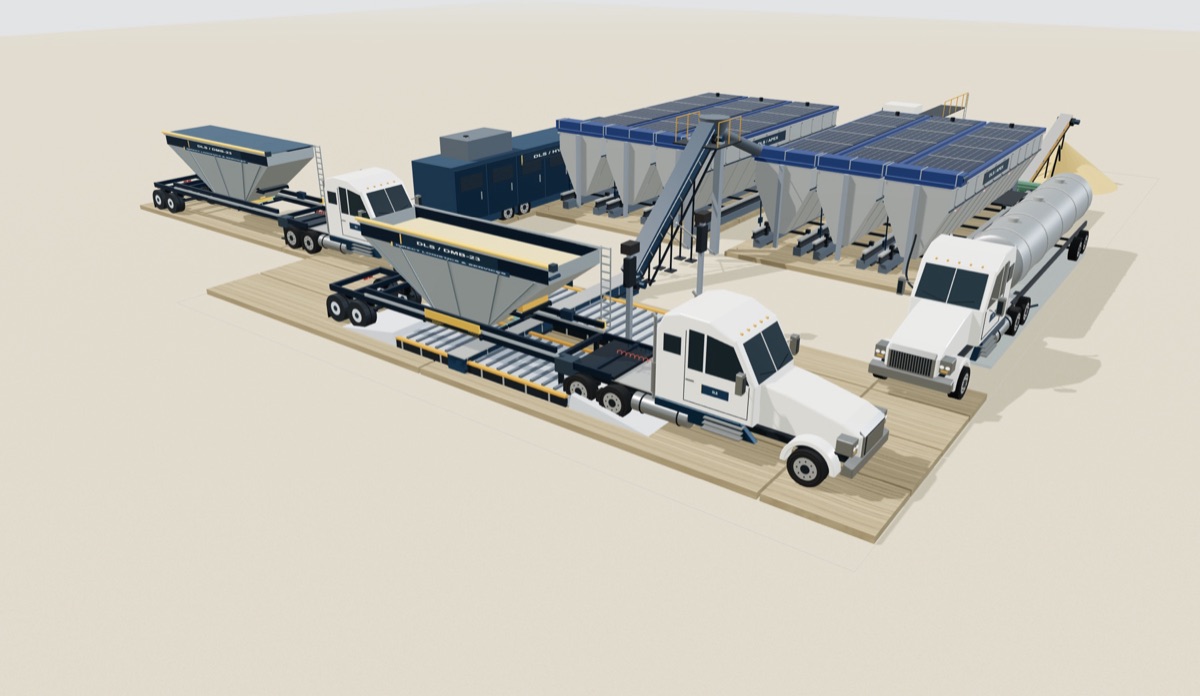
Interactive scale model of a 900-ton pad. Drag to orbit, click then scroll (or pinch) to zoom, tap any part for details. Concept visualization; dimensions are design targets. Open full screen →
900 tIn six 150-t storage cells (1,200 t with eight)
9 loadsAll legal width and height. No permits, no pilot cars
No craneCells settle onto the mats on their own rails
6–8 hRig-up with three people and a telehandler (target)
15 ftTallest work point, against roughly 60 ft on a silo system
The problem
From the completions seat, sand is five worries.
Waiting on sandA late wave of trucks or a frozen gate, and the pumps sit. The most expensive hour on the pad.
Tickets that don’t matchMine BOL, carrier ticket and what reached the blender rarely agree, and disputes drag on for weeks.
Dust paperworkSilica exposure records get demanded after the fact and assembled from memory.
Pad space and matsTall silos want double mats, a crane and a permit window that never lines up with the frac schedule.
The wrong trailersSystems built for one trailer type push the cheapest carriers off the job.
How sand moves
Any truck in. Measured sand out.
1Drive-over lanesTwo ground-level lanes take belly-dump, hopper-bottom and end-dump trailers on a four-minute cycle, guided by lane lights, with no spotter. Pneumatics fill through roof inlets.
2Incline & diverterAn enclosed incline conveyor lifts sand to a diverter that sends each load to the right cell and mesh.
3Six storage cellsTwo rows of three 150-t cells with load cells and level sensing. Every cell takes dry or damp sand.
4Two scaled collectorsEach row has its own collector: run 100 mesh and 40/70 side by side, or let one back the other up.
5To the blenderSand feeds the blender at the rate it asks for, targeted within ±2 %.
Where it’s built to be better
Against the three ways sand is stored today.
| Criterion | DLSAPEX design target | Silo systems | Box systems | Pile systems |
|---|---|---|---|---|
| Erection | None. Cells settle on their rails | Self-erecting hydraulics or crane | None (box swaps) | None |
| Permits to mobilize | None. 9 legal loads | Width permits on silo trailers | None per box; constant box traffic | None |
| Rig-up | 6–8 h target | About a day | Hours | Hours |
| Tallest work point | About 15 ft | About 60 ft | About 10 ft | Pile height |
| Wet and dry sand | Every cell, same path | Some configurations | Wet boxes available | Wet by nature |
| Trailer types | Belly, hopper-bottom, end-dump, pneumatic | Pneumatic, plus belly-dump options | Dedicated boxes and chassis | Belly-dump |
| Inventory & tickets | Load cells + scales; tickets on measured tons | Level sensing; software varies | Box counts | Loader estimate |
| Mats | About 35 | 60–90 | Varies | Few |
Competitor columns describe each category in general terms; specific products vary. DLSAPEX values are design targets to be proven in the pilot.
SandView
The completions view of the sand.
Hours of cover, not a levelInventory by mesh with a 12-hour forecast from your stage schedule, the live draw and the trucks on the road.
Tickets on measured tonsEvery load matched to load-cell and belt-scale weight; damp loads reported on a dry basis. Disputes settled the same day.
A stage report that writes itselfDesigned vs. delivered per stage, wait-on-sand minutes and the dust log, sent when the stage closes.
Live demo with sample data, not a real job. Open full screen →
Reliability & safety
Designed in, not promised.
Sized by simulation
Zero wait on normal days
A minute-by-minute model of a sand-heavy zipper fleet sized the 900 t to ride through a 90-minute road closure without starving the blender.
Two paths
Independent collectors
Each row feeds the blender on its own scaled collector, so one can carry the job while the other is serviced.
No one beside the truck
Guided lanes
Cameras and lane lights cue the driver and the gates; the lane stops itself if a person steps into the hopper zone.
Silica you can document
Per-stage dust log
Enclosed transfers, bin-vent filtration and continuous perimeter monitors produce an exposure record you can hand an auditor.
Runs without the cloud
Layered control
Lose the network and the pad keeps producing on local controls; the operator can always run it from the screen.
A third less diesel
Hybrid power
A Tier 4 Final genset paired with battery storage and rooftop solar, or shore power where it exists.
One accountable party
Trucks + pad + data
DLS runs the trucks, the dispatch desk, the pad system and the data. When sand is late, there’s one phone number.
Where we are
Concept design done. Pilot next.
Concept design packageArchitecture, module specs, pad layout, transport plan, simulation and compliance plan, independently reviewed once. Sept 2026.
Engineering & pilot buildStructural and vehicle engineering of the storage cell, bulk-solids flow study, and a two-cell, one-lane pilot with SandView. Target H1 2027.
Paid pilot on a partner padDLS intake, metering and SandView on storage you already trust, one job, against acceptance tests we agree on in advance.
Full 900-t systemTargeted for late 2027, contingent on the pilot.
One pad and one honest engineer.
Tell us which job a pilot could ride along on and what it would have to prove. You get the data either way.
Patent pending. The DLSAPEX Sand Solution is a concept in development. All capacities, cycle times, rig-up times, accuracy and emissions figures are design targets from the engineering package, to be proven in a pilot. The 3D model and SandView use illustrative geometry and sample data.